


Source: Do Dieu Khue.
Every weekday morning around eight-forty, a small group of parents and children gathers in front of BK Residence Hall, near the rear gate of Seoul National University (SNU). BK is not a residence only for visiting scholars, but it has long been home to a rotating mix of international students, researchers, and their families. Living on campus gives our daily lives a peculiar rhythm: physically in Seoul, yet partially insulated from the city beyond the university gate.
We are waiting for a daycare bus.
Children cling to jackets or run in circles. Parents exchange brief greetings in English, Hindi, Mandarin, Vietnamese and Korean. When the bus arrives, the children climb on, one by one. In the afternoon, the same yellow bus brings them back to the same spot. This quiet routine—unremarkable at first glance—has become my everyday lens for thinking about multiculturalism in South Korea, not as a policy slogan, but as something lived, negotiated, and quietly improvised.
Finding a Daycare in a Shrinking Society
I did not find my son’s daycare through an official government childcare portal,[1] university channels, or online rankings. I found it through another Vietnamese family who had lived at BK before us. Their son attended this daycare for two years.
“It’s not an international preschool,” they told me, smiling, “but you’ll see.”[2]
At the time, I did not fully understand what they meant.
Like many parents in Seoul, I soon encountered a paradox. Despite South Korea’s long-running demographic crisis—marked by one of the lowest fertility rates in the world—early childcare and preschool education remain intensely competitive. Although official statistics showed a slight rebound in births in 2024, the overall fertility rate remains far below replacement level, continuing a trend that has alarmed policymakers for over a decade (Kim 2025; OECD 2025).
This demographic pressure does not translate into relaxed competition. On the contrary, access to public or highly regarded daycare centers remains scarce. In Seoul, parents often try to secure places in preferred public childcare centers extremely early—sometimes even before birth—because public centers are widely viewed as more reliable (and often more affordable) than private alternatives, and demand continues to outstrip supply (Sung 2009; Cho 2025).
The most competitive option near us is the SNU Childcare Center. Admission prioritizes children of university staff and generally requires both parents to be employed—a persistent problem that has been reported a decade ago (Park 2014), with waiting periods that can stretch close to two years. As a visiting researcher with one working parent, my son was placed at number 33 on the waiting list. In practice, that meant no admission.
The reference to the SNU Childcare Center here is not meant as a critique of the institution itself. On the contrary, the center is widely recognized for its high-quality care, professional staff, and rich educational environment, and it remains the preferred option for many families affiliated with the university. My own experience of being unable to secure a place there reflects not institutional exclusion but structural conditions—particularly the limited number of places relative to demand, and eligibility rules shaped by employment status and administrative criteria. In this sense, the situation illustrates not a failure of the institution, but the broader pressures faced by childcare systems operating under demographic decline, labor precarity, and evolving family forms.
A Familiar Conversation
When South Korean colleagues learn that my son goes to daycare nearby, the conversation almost always follows the same path.
First question:
“Oh—does he go to the SNU Childcare Center?”
When I answer no and explain how competitive it is, the response is usually sympathetic. Then comes the second question, almost immediately:
“So… are you sending him to an international preschool?”
At this point, they have noticed that I am a foreigner. I usually laugh and reply:
“Yeah—kind of.”
And then I explain the real story.
Not an International Preschool, But an International Classroom
My son attends a private daycare center in the Inheon neighborhood of Gwanak District. This detail matters. Because it is private, the principal has greater autonomy over fees, programming, and daily practices—flexibility that public daycare centers generally do not have.
The daycare is not an elite international preschool of the kind found in Gangnam or Seocho, where monthly tuition often exceeds 1.3 million KRW and can reach two or three million KRW (No 2024; Korea Times 2025). It follows the South Korean childcare system. The teachers are Korean. The language of instruction is Korean.
And yet, the classroom is unmistakably international.
Most of the foreign children come from India, which forms the largest group, followed by Vietnam, China, Pakistan, Egypt, Iran, and several African countries. Their parents are graduate students, engineers, postdoctoral researchers, and visiting professors affiliated with SNU or nearby institutions. In practice, the daycare has become international not by design, but by circumstance—shaped by demographic decline, academic mobility, and the geography of a university campus.
Recruitment in Plain Sight
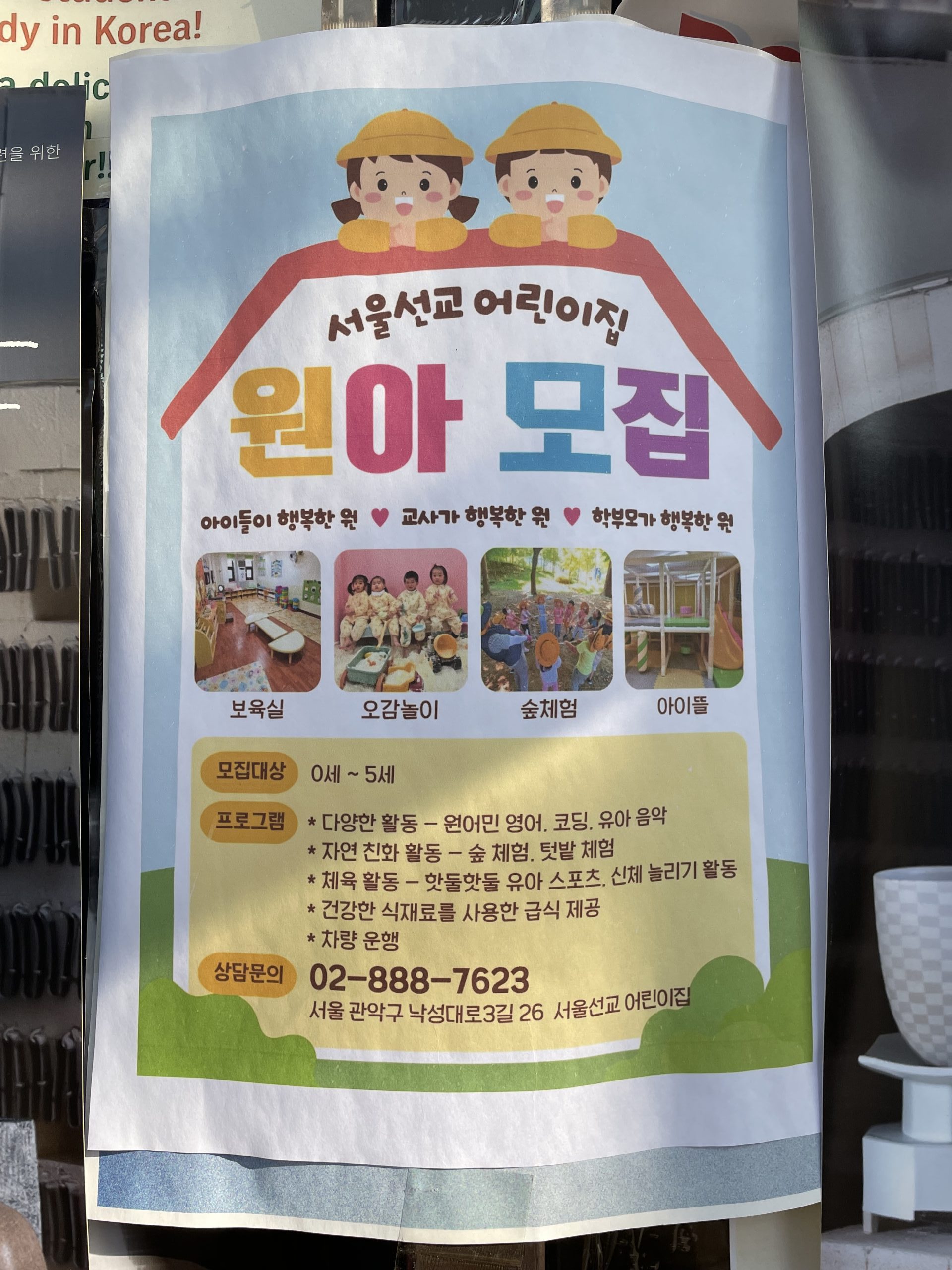
The demographic pressures facing South Korean preschools are visible just outside our daily routine. At the bus stops directly in front of and opposite BK, recruitment posters from other nearby private daycare centers are posted openly, advertising enrollment.
Source: Do Dieu Khue.
These posters are not from my son’s daycare, but they tell the same story. While some elite institutions maintain long waiting lists, many private preschools struggle to fill classrooms. International families—who pay tuition in a system where education is free for South Korean citizens—have become an important, if unofficial, source of stability.[3][i]
Multiculturalism by Discretion
Because my son’s daycare is private, the principal can exercise discretion in ways that are both pragmatic and inclusive. Over time, this has translated into several practices:
- bus fees and extra charges (uniforms, special programs) are often waived for foreign children;
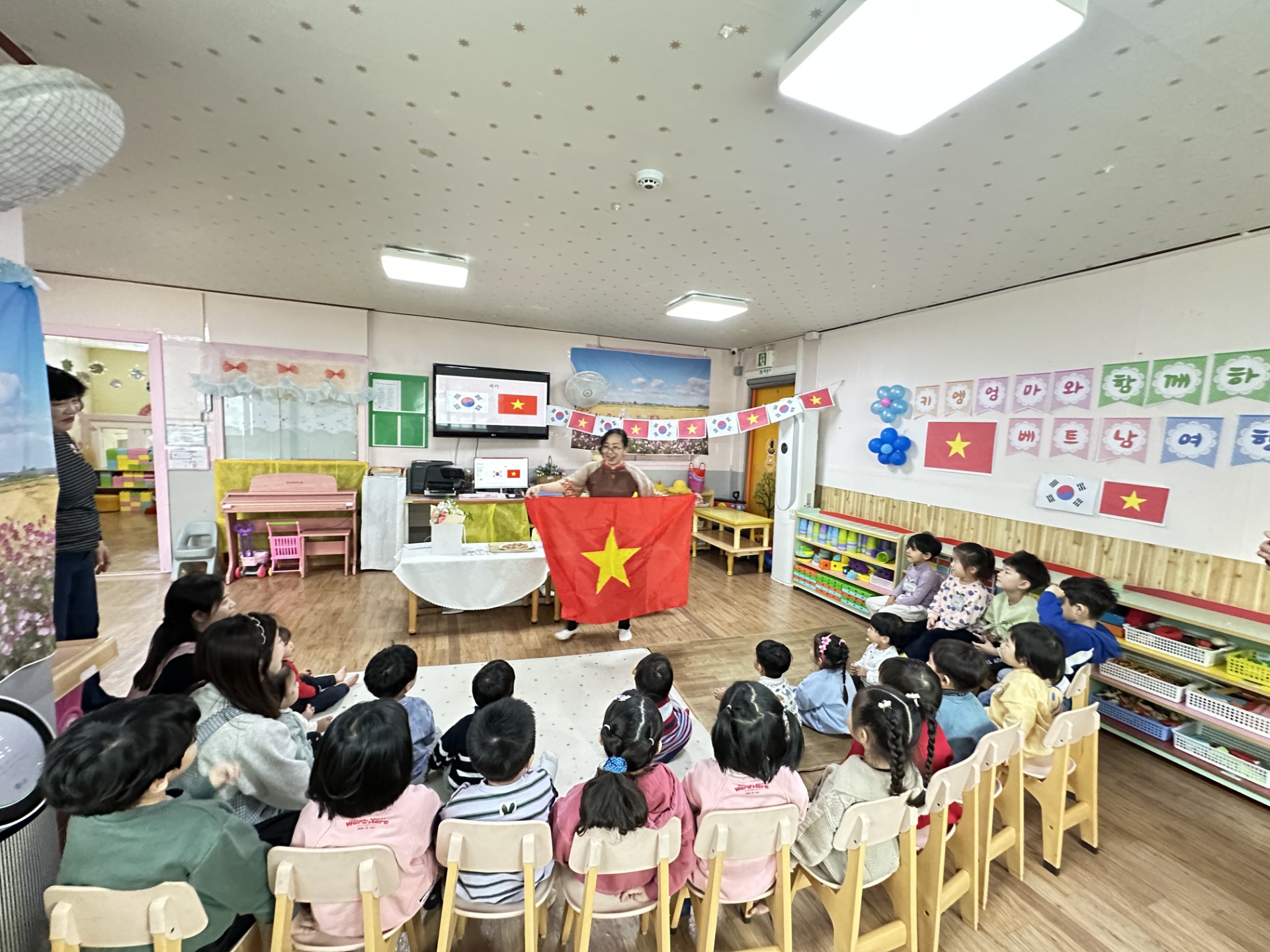
- the daycare organizes monthly multicultural sessions;
- parents are invited to introduce their home countries.
During one such session, I was invited to talk about Vietnam—its geography, food, and festivals.
Source: Do Dieu Khue.
These activities are warmly received by children and parents alike. Yet they are not required by government policy, nor supported by public funding. They exist because the principal believes they are good for the children—and because the daycare relies, increasingly, on international families to sustain enrollment.
Recent empirical research helps contextualize why this matters. A 2025 study published in International Journal of Early Childhood found that childcare center teachers in South Korea reported the lowest levels of multicultural awareness compared to kindergarten and elementary school teachers, raising concerns about institutional preparedness for growing diversity (Kim et al. 2025). Against this backdrop, the practices of my son’s daycare appear less typical than exceptional.
Inclusion Ahead of Policy
South Korea officially embraced multiculturalism in the mid-2000s, culminating in the Multicultural Families Support Act of 2008. The law was designed to support families formed through marriage migration and to help their children adapt and achieve economic self-reliance.
However, the Act defines “multicultural families” narrowly: families in which one spouse is a South Korean citizen and the other is a marriage migrant, or where both spouses have naturalized through marriage (Republic of Korea 2008). Families like ours—where both parents are foreign nationals living legally in Korea—do not fall within this definition. As a result, children from international families often remain outside the scope of formal multicultural support, despite attending South Korean childcare institutions and participating fully in everyday school life.
Scholars of South Korean multiculturalism have long noted this gap between lived diversity and legal recognition, arguing that multicultural policy has developed unevenly and remains closely tied to specific family categories rather than broader patterns of migration and mobility (Lim 2020).
Word of Mouth as Infrastructure
Over time, I noticed something else. Based on my son’s positive experience, I have helped introduce at least four other foreign families to this daycare. They enrolled their children not because of policy incentives or official guidance, but because someone they trusted said, “This place is good.”
This is how inclusion often works in practice: through informal networks, personal recommendations, and quiet adjustments. It is effective—but fragile. It depends on goodwill, individual leadership, and demographic necessity rather than on rights or institutional guarantees.
Around this small community, an informal ecosystem has also taken shape. Parents share information not only about childcare, but also about clinics, pediatricians, and dental practices known to accommodate non-Korean speakers. Families gravitate toward a small network of providers who are experienced with foreign patients. In everyday terms, this word-of-mouth infrastructure becomes a practical guide to navigating life with young children in South Korea—especially when official guidance is limited or hard to access.
A Small Conclusion from in Front of BK
Every afternoon, when the yellow bus drops the children back in front of BK, the scene repeats itself. Parents wave. Children run toward familiar doors. Life resumes its ordinary rhythm.
The daycare is sometimes jokingly described as “international.” The joke works because it points to a deeper reality. Diversity is already present in everyday life in South Korea, not through grand declarations, but through small decisions made by private institutions and individual actors.
Two decades after declaring itself a multicultural society, South Korea has built policies that recognize some forms of diversity while overlooking others. Until that gap is addressed, inclusion will continue to arrive quietly—every morning, in front of BK.
저자 소개
Do Dieu Khue (dokhue2023@snu.ac.kr)
is a Visiting Scholar at SNU AC. Her research mainly resolves around modern Korean history, U.S. relations with East and Southeast Asia throughout the Cold War, and the dynamics among Asian Socialist states. She previously served as an Assistant Professor of International Politics at the University of Social Sciences and Humanities, Vietnam National University-Ho Chi Minh; a Visiting Fellow at the Harvard-Yenching Institute; and a Visiting Researcher at the George Washington University, SNU Institute of International Studies, and SNU Institute of Humanities.
Do Thanh Thao Mien (dothaomien@gmail.com)
is a lecturer of Korean Studies at the Faculty of International Politics and Diplomacy, Diplomatic Academy of Vietnam. She held an MA in Korean Studies from SNU and a Ph.D. in History from Ewha Womans University. She has conducted research on modern Korea, Korea-Vietnam interactions and the Vietnam War. While serving as a Visiting Scholar at SNU AC, she published her first book, Between Blood Ally and Self-Interest: Pyongyang, Hanoi and the War in Vietnam (in Korean, SNU Press, 2023).
참고문헌
Cho, Jung-woo. 2025. “For working parents, finding day care spots a frustratingly long grueling experience.” Korea JoongAng Daily. https://koreajoongangdaily.joins.com/news/2025-10-22/national/socialAffairs/For-working-parents-finding-day-care-spots-a-frustratingly-long-grueling-experience/2425095 (Accessed: 20/Nov/2025).
Jung, Da-hyun. 2025. “Seoul expands child care subsidy age limit for foreign residents.” The Korea Times. https://www.koreatimes.co.kr/southkorea/society/20250217/seoul-expands-child-care-subsidy-age-limit-for-foreign-residents (Accessed: 12/Oct/2025).
Kim, Hyung-jin. 2025. “South Korea sees first rise in births in nearly a decade, but fertility remains among world’s lowest.” AP News. https://apnews.com/article/south-korea-babies-fertility-rate-dde1e536cd8b7a65cf30fe3f91983162 (Accessed: 20/Nov/2025).
Kim, Hyun-Jung et al. 2025. “Multicultural Awareness and Educational Continuity among Early Childhood and Elementary School Teachers in South Korea.” International Journal of Early Childhood.
https://link.springer.com/article/10.1007/s13158-025-00431-7 (Accessed: 8/Jan/2026).
Korea Times. 2025. “$11,000 Tuition and Toddler Test: Korean English Preschools Spark Concern.” https://www.koreatimes.co.kr/southkorea/society/20250611/11000-tuition-and-toddler-tests-korean-english-preschools-spark-concern (Accessed: 20/Nov/2025).
Lim, Timothy C. 2020. The Road to Multiculturalism in South Korea: Ideas, Discourse and Institutional Change in a Homogenous Nation-State. London: Routledge.
No, Kyung-min. 2024. “College is expensive? In S. Korea, English Preschools Cost Much More.” The Korea Herald. https://www.koreaherald.com/article/3482228 (Accessed: 20/Nov/2025).
OECD. 2025. Korea’s Unborn Future: Demographic Change and Policy Challenges.
https://www.oecd.org/en/publications/korea-s-unborn-future_005ce8f7-en.html (Accessed: 20/Nov/2025).
Park, Su-ji. 2014. “Reading, writing and childrearing: the tough lives of studying Moms.” Hankyoreh. https://www.hani.co.kr/arti/english_edition/e_national/636252.html (Accessed: 12/Oct/2025).
Republic of Korea. 2008. Multicultural Families Support Act. Act No. 8091.
https://elaw.klri.re.kr/eng_service/lawView.do?hseq=29049&lang=ENG (Accessed: 8/Jan/2026).
Sung, So-young. 2009. “Grandma gets the kids.” Korea JoongAng Daily. https://koreajoongangdaily.joins.com/2009/07/08/features/Grandma-gets-the-kids/2907161.html (Accessed: 12/Oct/2025).
각주
[1] Also called as “i-Sarang (아이사랑)” – https://www.childcare.go.kr/?menuno=1
[2] In practice, many urban childcare centers combine functions of care (보육, 육아) and early education (유아교육), blurring the formal distinction between daycare (어린이집) and preschool/kindergarten (유치원).
[3] Since 2025, the Seoul Metropolitan Government has expanded childcare subsidies for foreign residents, allowing eligible families to receive up to a 50 percent fee reduction depending on a child’s age and the family’s residency status (Jung 2025). This policy shift reflects growing recognition of international families in childcare provision. However, the support remains partial and was not available to many families—including the author’s—during earlier periods of residence.
