

(source: https://commons.wikimedia.org/wiki/File%3ATskhay-bozumbayev-na-k-park-2025.jpg)
The Bridge Everyone Speaks Of
Restructured supply chains, competition for energy and minerals, and the search for new routes between Europe and Asia have turned Central Asia, long seen as a geopolitical periphery, into a field of cooperation in its own right.
Kazakhstan holds a special place for the Republic of Korea, which officially calls it its largest trade and investment partner in Central Asia (Office of the President 2026a). Its significance is not only economic. Kazakhstan is home to a Korean community that President Kassym-Jomart Tokayev described as numbering about 120,000 in September 2026 (Kazpravda.kz 2026), whose history there began almost ninety years ago with the 1937 deportation of Soviet Koreans from the Russian Far East. This history does not explain current cooperation or guarantee its success, but it gives the relationship a historical and social depth that is present, in one way or another, in how each side speaks of the other.
By 2026 the bilateral agenda ranged from oil and critical minerals to artificial intelligence and Korean participation in Alatau City, a new city that Kazakhstan is building near Almaty as a national project. At the first Korea–Central Asia Summit, in Seoul in September 2026, the two countries upgraded their relations to a “future-oriented comprehensive strategic partnership”.
In the official rhetoric of those days, the Koryo-saram appeared almost every time Kazakhstan came up, nearly always as a “bridge”. Announcing the summit, the Office of the President of the Republic of Korea called them a sturdy bridge of Korea–Central Asia cooperation and promised to turn ties built through the community into a “key asset” for the future (Office of the President 2026b). After their talks on 15 September, the two presidents noted that Kazakhstan’s Koryo-saram community had served as a valuable bridge between their countries (Office of the President 2026a). Opening the multilateral summit, President Lee Jae Myung linked the bridge role the Koryo-saram began to play some ninety years ago to cooperation in trade, investment, infrastructure, education and culture (Office of the President 2026c). The same day Tokayev called them a “golden bridge” of friendship (Kazpravda.kz 2026). The metaphor belongs to both sides.
What was new was not the metaphor but its extension, at the highest political level, to practically every area of the relationship. The wider its scope, the less it tells us: when cooperation includes investment, infrastructure and business projects, does the “bridge” remain an image of historical connection or acquire new institutional content? The answer should probably be sought in the documents where it is supposed to become concrete decisions.
One Bridge, Many Documents
The literature on diaspora entrepreneurship describes a diaspora’s position between homeland and country of residence as “in-between” (Brinkerhoff 2016), and the Korean “bridge” can be read as a public version of this idea, voiced by a state that maintains its own institutions for engaging with Koreans overseas (Gamlen 2014). The same literature cautions that the position of diaspora actors depends on context and relations, not only on origin (Koinova 2017), and that ethnic ties do not become an operative resource merely because they are recognised (Anthias 2007). Calling a community a “bridge” does not yet tell us where its members and organisations are positioned within cooperation.
The texts in which the metaphor appears do not describe the Koryo-saram in the same way. Where the subject is memory, anniversaries or diaspora policy, Koryo-saram identity is, as a rule, stated openly. In documents on economic projects, the same people often appear as company heads, council members or parties to agreements, with their origin unmentioned. In materials addressed to a Korean audience these categories are joined again.
This does not tell us which role is the “real” one, still less that the absence of diaspora language means the absence of participation. Public texts show how cooperation is represented, not what happened beyond them; the September 2026 memoranda and the full Seoul Declaration are unpublished and known only from official statements. What follows traces how the same people and projects are positioned across document types, not who influenced what.
Remembering Together: The Bridge as Memory Policy
It is in the interstate documents that the Koryo-saram are most readily called a bridge, yet the decisions that follow are fairly specific. At the bilateral summit, the official briefing states, the leaders agreed, ahead of the 90th anniversary of Koryo-saram settlement in Central Asia, to deepen cooperation in preserving historical sites and records of the Korean independence movement, so as to carry this bond forward to future generations (Office of the President 2026a). The briefing assigns the 13 documents signed that day to energy, science and technology, future aviation, urban development and climate; the commemorative commitment appears as an agreement between the leaders rather than as part of the economic agenda.
At the multilateral summit, according to the official account, the Seoul Declaration named “connection through people and trust” as one of four directions of cooperation, and the parties agreed to jointly commemorate the 90th anniversary, honouring the historical bridge role of the Koryo-saram and strengthening ties between future generations (Office of the President 2026d). The instruments named are training, exchanges, air links and tourism; the “key asset” had likewise been spelled out through Korean language education and youth exchange rather than economic mechanisms (Office of the President 2026b). The agenda also took budgetary form: the Overseas Koreans Agency (OKA) included in its draft 2027 budget, for the first time, a line for the 90th anniversary of the deportation (Yonhap 2026a).
Nor did this agenda originate only with states. The Association of Koreans of Kazakhstan (AKK) tied its K-Park project to the anniversary in 2025, presenting it that April at the Korean Embassy in Astana as a symbol of gratitude to the Kazakh people (Koryo Ilbo 2025). This shows that the theme was present in the community’s relations with Korean institutions well before the summit, not how it entered the outcome documents, whose subjects remain states.
Two features stand out. The first is grammatical: the bridge almost always appears in the past or perfect tense, as something the Koryo-saram “have served” as. It appears first of all as a recognition of past contribution, while the most directly forward-looking part of its institutional content is associated with education, exchanges and ties between generations. The second concerns whose heritage is preserved. Independence-movement sites in Kazakhstan belong above all to Korean national memory, so recognising the bridge also brings the community into Korea’s own national narrative, consistent with Gamlen’s observation that states “embrace” diasporas within the space of national identity (Gamlen 2014).
Building Together: Alatau City in the Language of Projects
The same September package also had an economic part, in which the Koryo-saram are not mentioned. Its main object, Alatau City, is a state project of Kazakhstan, whose special status, development council and legal regime were established by presidential decrees and a Constitutional Law in 2025–2026 (Kazakhstan Today 2025; Zakon.kz 2026; Akorda 2026). Korea is one of several international partners, not the project’s initiator.
In Kazakh government documents on Alatau City’s cooperation with Korea, the Koryo-saram do not appear as such, although people associated with the community do. Reporting on the “Alatau Rise” roadshow in Seoul in October 2025, the Office of the Prime Minister names Yuriy Tskhay as a member of the Alatau City Development Council and chairman of Caspian Group (Office of the Prime Minister of Kazakhstan 2025).
Korean documents use the same language. The bilateral summit briefing lists the “new city of Alatau” alongside artificial intelligence and a Kazakh institute modelled on KAIST, without mentioning the Koryo-saram (Office of the President 2026a). On 16 September Hyundai Motor Group signed an agreement to advance the Alatau project; its release describes Caspian Group as a private investment company and Alatau as a special economic zone with national-project status (Hyundai Motor Group 2026). The Ministry of Trade, Industry and Resources presented the same deal as a “physical AI-based smart city” memorandum (MOTIR 2026). The two sources name the other Kazakh party differently, United Group Alatau in Hyundai’s version and Kaspi in the ministry’s, and neither contains the words “Koryo-saram”, “diaspora”, “overseas Koreans”, “heritage” or “bridge”.
Within a single summit, memory and projects ended up in separate places: the bridge was named where the subject was the past and future generations, while builders appeared as companies, councils and investors. The boundary matters: bridge language is absent from the state and contractual documents on Alatau examined here, not from all economic communication around Alatau.
Alatau’s other international directions suggest that this corporate and governmental vocabulary is ordinary for the project. When Kazakhstan presented Alatau in Shenzhen and Hong Kong in June 2026 (Office of the Prime Minister of Kazakhstan 2026; HKTDC 2026), the actors in the available materials were state bodies and trade-promotion organisations, and no diaspora institutions were visible. This does not show that there were no diaspora intermediaries, only that Alatau’s internationalisation does not require diaspora language. The Korean dimension stands out because such language does appear around it. The question is where.
When the Bridge Talks Business Again
Promotion aimed at a Korean audience provides the answer. In the Korean press, the same Seoul roadshow looked different. According to an announcement by Samjong KPMG, it was organised by the government of Kazakhstan and a “Koryo-saram company”, with key figures of a Koryo-saram business network acting as a “think tank” (Etoday 2025). According to Korean media reports, Tskhay called the community a “bridge of trust” between the two countries and the project symbolic, going beyond economic cooperation (SmartBizN 2025). The programme was also to include a presentation of K-Park by AKK (ABC News 2025).
Ahead of the summit, a Yonhap series on Central Asian Koryo-saram sharpened this line: it called the community a “strategic asset”, discussed Alatau City and K-Park together, and described Koryo-saram entrepreneurs across the region who have local networks as “private economic diplomats” (Yonhap 2026b). A 17 September Yonhap article introduced Tskhay as a Koryo-saram businessman, chairman of Caspian Group and current chairman of AKK; in it he himself suggests that Korean companies draw on the community’s business networks in Kazakhstan (Yonhap 2026c).
These texts show that a person’s title changes with the genre of the document. On the website of AKK, which Tskhay has again headed since early 2025, all his positions are listed side by side: chairman of the Association and its Board of Trustees, Chairman of the Board of Directors of JSC Caspian Group, member of the Alatau City Development Council (AKK n.d.a). State and contractual texts select the business position, commemorative texts the community position, and Korean media combine the two. The person does not change; what changes are the relations within which he is described.
This observation concerns public language: it allows no judgement on whether titles are chosen deliberately or whether actual mediation lies behind “private economic diplomats”; recognition of an ethnic tie and its actual role, as Anthias reminds us, are different things (Anthias 2007). It does, however, locate the bridge in the economic sphere: it returns mainly as a promotional language of trust and strategic value, without becoming an institutional category in the agreements. Is there an object in which the commemorative and project registers meet in the project’s own official documentation?
K-Park: Memory inside a Development Project
There is: K-Park. According to current AKK information, it is an international cultural and business centre of about 10 hectares in Alatau’s Golden District, developed by the Association of Koreans of Kazakhstan and due to open in 2027, the 90th anniversary year (AKK n.d.b).
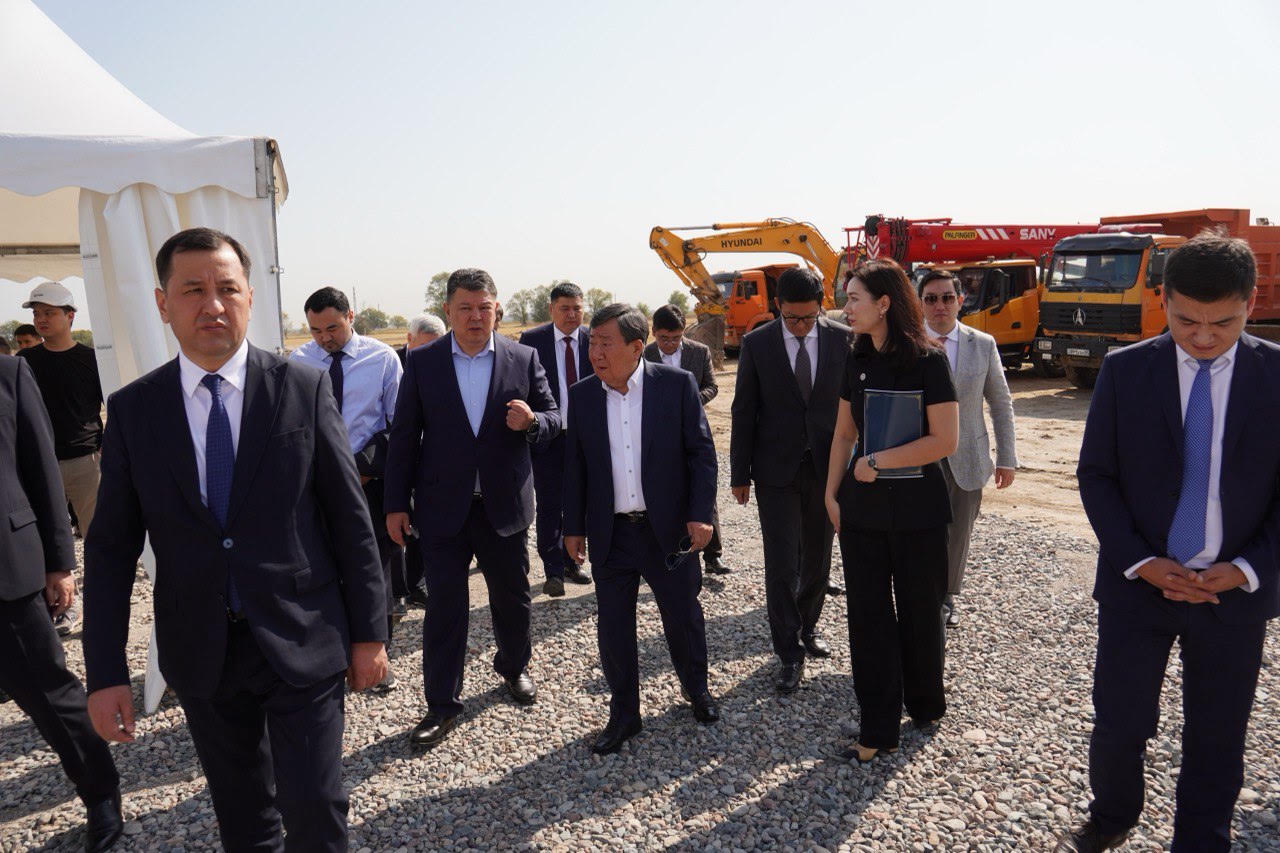
More significant is how the state project describes it. Its official website presents the stone-laying of September 2025 as the start of the new city’s first investment project, dedicated to the 90th anniversary of Koreans in Kazakhstan (Alatau City 2025a). Tskhay attended, this time as chairman of AKK, alongside the regional governor, the Korean Consul General and an OKA official, who called both new “boosters” for Kazakhstan’s development (Alatau City 2025c). Alatau City’s review of 2025 calls it the city’s first anchor project (Alatau City 2025b).
K-Park thus brings together what appeared separately in the interstate and contractual documents: community memory tied to the 90th anniversary; the initiative of a diaspora organisation, with Korea’s overseas Korean policy represented by OKA; and a place in Alatau’s urban plan described in the investment language of a state project. These elements appear in one document, drawn up by the state project itself.
How far this combination reaches beyond Alatau can be partly judged from OKA’s World Korean Week in late September 2026. At OKA’s Future Leaders Conference, the chairman of the Koryo-saram Youth Union of Kazakhstan was introduced through his birthplace, Ushtobe, known as the first settlement of the deportees, and his wish to connect Koryo-saram youth with their peers worldwide (Newskorea 2026). At the World Korean Business Convention, Tskhay was introduced as the Caspian Group chairman “building K-Park in Kazakhstan” (Jaeoe Dongpo Sinmun 2026), his business position identified through a commemoratively conceived object rather than through Alatau. The two episodes are unconnected and analytically distinct; together they show only that memory, youth policy and diaspora business were appearing within the same broader space of Korea’s policy towards overseas Koreans.
K-Park matters here for this combination of registers, not for any consequences. The published materials give no grounds for linking it to the Hyundai agreement, the KAIST-modelled institute or Korean investment in general, and what it will become after 2027 cannot yet be said.
A Bridge in Several Registers
The limitation of the bridge metaphor is not that it is false, since each source taken alone tends to confirm it, but that it compresses into one public category meanings that do not coincide institutionally. In interstate policy, the bridge looks to the past and is translated into memory, heritage and ties between generations. In state and contractual economic documents, the same people and projects appear as companies, chairmen, council members and investment projects. In promotion aimed at a Korean audience, the bridge returns to the economy as a language of trust and strategic value rather than as a category of agreements.
These meanings do not contradict one another, but neither do they coincide, and while the Koryo-saram are spoken of as a bridge in general, the difference remains invisible. K-Park is the clearest of the points examined at which commemorative and project meanings are fixed in a single official document, and probably where changes in their relationship after 2027 will be easiest to observe.
How Koryo-saram participation is actually organised, and whose influence shapes it, lies beyond public documents. Even so, the comparison shows that the symbolic recognition, institutional positioning and economic presentation of a community are not the same thing. In September 2026 states agreed to remember together, companies agreed to build together, and the Korean press spoke of both as a bridge. The bridge, it seems, acquires its meaning according to the institutional context and the kind of cooperation in which it is invoked.
Author Introduction
Natalya Yem (natalya_yem@snu.ac.kr; natalya.yem@kaznu.edu.kz)
is a Visiting Scholar at the Seoul National University Asia Center and an Associate Professor at Al-Farabi Kazakh National University. She holds a Ph.D. in History. Her research focuses on diaspora and migration, ethnic identity, transnational marriage, and Russian-speaking migrants in South Korea. Her current research examines Korea–Kazakhstan cooperation, diaspora engagement, and transnational networks in Central Asia.
References
Office of the President (Republic of Korea). 2026a. «한-카자흐스탄 정상회담 결과 관련 강유정 수석대변인 서면 브리핑» [Written briefing by Senior Spokesperson Kang Yu-jung on the outcomes of the Korea–Kazakhstan summit]. 15 September. https://www.president.go.kr/briefings/8RNOLYMn (Accessed: October 2, 2026).
Office of the President (Republic of Korea). 2026b. «「제1차 한-중앙아시아 정상회의」개최(9.16) 관련 강유정 수석대변인 서면브리핑» [Written briefing by Senior Spokesperson Kang Yu-jung on the holding of the First Korea–Central Asia Summit (16 September)]. 11 September. https://www.president.go.kr/briefings/8RvaLYMn (Accessed: October 2, 2026).
Office of the President (Republic of Korea). 2026c. «9/16(수) 한-중앙아시아 정상회의 개회사» [Opening remarks at the Korea–Central Asia Summit, 16 September (Wednesday)]. 16 September. https://www.president.go.kr/speeches/uFoI1oOc (Accessed: October 2, 2026).
Office of the President (Republic of Korea). 2026d. «「제1차 한-중앙아시아 정상회의」결과 관련 성기홍 홍보소통수석 서면 브리핑» [Written briefing by Senior Secretary for Public Relations Seong Gi-hong on the outcomes of the First Korea–Central Asia Summit]. 16 September. https://www.president.go.kr/briefings/Sev68dhP (Accessed: October 2, 2026).
Yonhap. 2026a. «[동포의 창] 동포청 내년 예산안 21.4% 증가한 1천369억원 편성» [Window on Overseas Koreans: Overseas Koreans Agency’s draft budget for next year set at 136.9 billion won, up 21.4%]. 1 September. https://m.news.nate.com/view/20260901n29825 (Accessed: October 2, 2026).
Hyundai Motor Group. 2026. «현대자동차그룹, 카자흐스탄 기업과 알라타우 시티 사업 추진 협약 체결» [Hyundai Motor Group signs agreement with Kazakh companies to advance the Alatau City project]. 17 September. https://www.hyundaimotorgroup.com/ko/news/hyundai-motor-group-alatau-city-development-agreement (Accessed: October 2, 2026).
Ministry of Trade, Industry and Resources of the Republic of Korea (MOTIR). 2026. «(참고자료) 「제1차 한-중앙아 비즈니스 서밋」 개최» [(Background material) First Korea–Central Asia Business Summit held]. 16 September. https://www.motir.go.kr/kor/article/ATCL3f49a5a8c/172208/view (Accessed: October 2, 2026).
Etoday. 2025. «삼정KPMG, 카자흐스탄 정부∙기업과 ‘알라타우 신도시’ 개발 로드쇼 개최» [Samjong KPMG holds ‘Alatau new city’ development roadshow with Kazakh government and companies]. 13 October. https://www.etoday.co.kr/news/view/2514008 (Accessed: October 2, 2026).
SmartBizN. 2025. «韓 기업, 중앙아 진출 물꼬 트다···카자흐 ‘알라타우 시티’ 로드쇼» [Korean companies open the way into Central Asia… Kazakhstan’s ‘Alatau City’ roadshow]. 15 October. http://www.smartbizn.com/news/articleView.html?idxno=122734 (Accessed: October 2, 2026).
ABC News. 2025. «카자흐스탄-한국, 차세대 산업 협력 논의…’알라타우 시티’ 프로젝트 로드쇼 개최» [Kazakhstan and Korea discuss next-generation industrial cooperation… ‘Alatau City’ project roadshow held]. 12 October. https://www.abcn.kr/news/articleView.html?idxno=83433 (Accessed: October 2, 2026).
Yonhap. 2026b. “[Korea-Central Asia: Part 4] Koryo-in People: From Pioneers of Barren Lands to Key Players in Eurasian Cooperation.” 11 September. https://korean-vibe.com/news/newsview.php?ncode=1065557642130118 (Accessed: October 2, 2026).
Yonhap. 2026c. «[동포의 창] “강제이주 90주년 내년 K파크 탄생…전세계 고려인 카자흐로”» [Window on Overseas Koreans: “K-Park to be born next year for the 90th anniversary of the forced relocation… Koryo-saram from around the world to Kazakhstan”]. 17 September. https://www.koreancenter.or.kr/news/articleView.html?idxno=1411832 (Accessed: October 2, 2026).
Newskorea. 2026. «27개국 차세대동포 리더 59명 송도 집결…’세계한인차세대대회’ 개막» [59 next-generation overseas Korean leaders from 27 countries gather in Songdo… ‘World Korean Future Leaders Conference’ opens]. 29 September. https://www.newskorea.ne.kr/news/articleView.html?idxno=21631 (Accessed: October 2, 2026).
Jaeoe Dongpo Sinmun (재외동포신문). 2026. «[현장] “대체불가 한상 저력, 대체불가 대한민국 큰 미래 향해”» [On site: “The irreplaceable strength of Hansang, toward a greater future for an irreplaceable Korea”]. 29 September. https://www.dongponews.net/news/articleView.html?idxno=60814 (Accessed: October 2, 2026).
Alatau City. 2025a. “The Foundation Stone Laying Ceremony for the K-park Project Took Place in Alatau City.” 12 September. https://alatau.city/news/the-foundation-stone-laying-ceremony-for-the-k-park-project-took-place-in-alatau-city (Accessed: October 2, 2026).
Alatau City. 2025b. “Alatau City in 2025: Year in Review.” 31 December. https://alatau.city/news/alatau-city-in-2025-year-in-review (Accessed: October 2, 2026).
Alatau City. 2025c. “Photo Report: The First Stone of K-Park Laid in Alatau City.” 16 September. https://alatau.city/news/photo-report-the-first-stone-of-k-park-laid-in-alatau-city (Accessed: October 13, 2026).
Office of the Prime Minister of Kazakhstan. 2025. “Deputy Prime Minister Kanat Bozumbayev Presented Alatau City Project at Roadshow in South Korea.” 15 October. https://primeminister.kz/en/news/deputy-prime-minister-kanat-bozumbayev-presented-alatau-city-project-at-roadshow-in-south-korea-30617 (Accessed: October 2, 2026).
Kazpravda.kz. 2026. «Президент провел встречу со спикером Национальной Ассамблеи Республики Корея» [The President met the Speaker of the National Assembly of the Republic of Korea]. 16 September. https://kazpravda.kz/n/prezident-provel-vstrechu-so-spikerom-natsionalnoy-assamblei-respubliki-koreya/ (Accessed: October 2, 2026).
Koryo Ilbo (Коре Ильбо). 2025. «АКК презентовала проект K-Park южнокорейскому посольству» [AKK presented the K-Park project to the South Korean Embassy]. 18 April. https://koreilbo.com/news/akk-prezentovala-proekt-k-park-yuzhnokoreyskomu-posolstvu/ (Accessed: October 2, 2026).
Kazakhstan Today. 2025. «Специальный статус города Алатау: Токаев подписал указ» [Special status of the city of Alatau: Tokayev signed a decree]. 26 September. https://www.kt.kz/rus/state/spetsialnyy_status_goroda_alatau_tokaev_podpisal_ukaz_1377982539.html (Accessed: October 2, 2026).
Zakon.kz. 2026. «Алатау получил уникальный статус: Касым-Жомарт Токаев подписал новый закон» [Alatau received a unique status: Kassym-Jomart Tokayev signed a new law]. 8 May. https://www.zakon.kz/politika/6517237-alatau-poluchil-unikalnyy-status-kasymzhomart-tokaev-podpisal-novyy-zakon.html (Accessed: October 2, 2026).
Akorda (Office of the President of the Republic of Kazakhstan). 2026. «Главой государства подписан Указ „О внесении изменений и дополнений в Указ Президента Республики Казахстан от 26 сентября 2025 года № 1015 „О некоторых вопросах развития города Алатау“» [The Head of State signed the Decree “On Amendments and Additions to Decree of the President of the Republic of Kazakhstan No. 1015 of 26 September 2025 ‘On Certain Issues of the Development of the City of Alatau’”]. 8 July. https://www.akorda.kz/ru/glavoy-gosudarstva-podpisan-ukaz-o-vnesenii-izmeneniy-i-dopolneniy-v-ukaz-prezidenta-respubliki-kazahstan-ot-26-sentyabrya-2025-goda-1015-o-nekotoryh-voprosah-razvitiya-goroda-alatau-86168 (Accessed: October 2, 2026).
Office of the Prime Minister of Kazakhstan. 2026. “International Roadshow of Alatau City Held in Shenzhen.” 10 June. https://primeminister.kz/en/news/international-roadshow-of-alatau-city-held-in-shenzhen-31503 (Accessed: October 2, 2026).
HKTDC (Hong Kong Trade Development Council). 2026. “Central Asia Visit Momentum Continues as Alatau City Investment Promotion Event Held in Hong Kong.” 11 June. https://en.acnnewswire.com/press-release/english/107692/central-asia-visit-momentum-continues-as-alatau-city-investment-promotion-event-held-in-hong-kong (Accessed: October 2, 2026).
Association of Koreans of Kazakhstan (AKK). n.d.a. «Административно-руководящий состав АКК» [Administrative and executive staff of AKK]. https://koreans.kz/head; «История Ассоциации» [History of the Association]. https://koreans.kz/history (Accessed: October 2, 2026).
Association of Koreans of Kazakhstan (AKK). n.d.b. «K-PARK». https://koreans.kz/kpark (Accessed: October 2, 2026).
Anthias, Floya. 2007. “Ethnic Ties: Social Capital and the Question of Mobilisability.” The Sociological Review 55 (4): 788–805. https://doi.org/10.1111/j.1467-954X.2007.00752.x
Brinkerhoff, Jennifer M. 2016. Institutional Reform and Diaspora Entrepreneurs: The In-Between Advantage. Oxford: Oxford University Press. https://doi.org/10.1093/acprof:oso/9780190278229.001.0001
Gamlen, Alan. 2014. “Diaspora Institutions and Diaspora Governance.” International Migration Review 48 (S1): S180–S217. https://doi.org/10.1111/imre.12136
Koinova, Maria. 2017. “Beyond Statist Paradigms: Sociospatial Positionality and Diaspora Mobilization in International Relations.” International Studies Review 19 (4): 597–621. https://doi.org/10.1093/isr/vix015
