

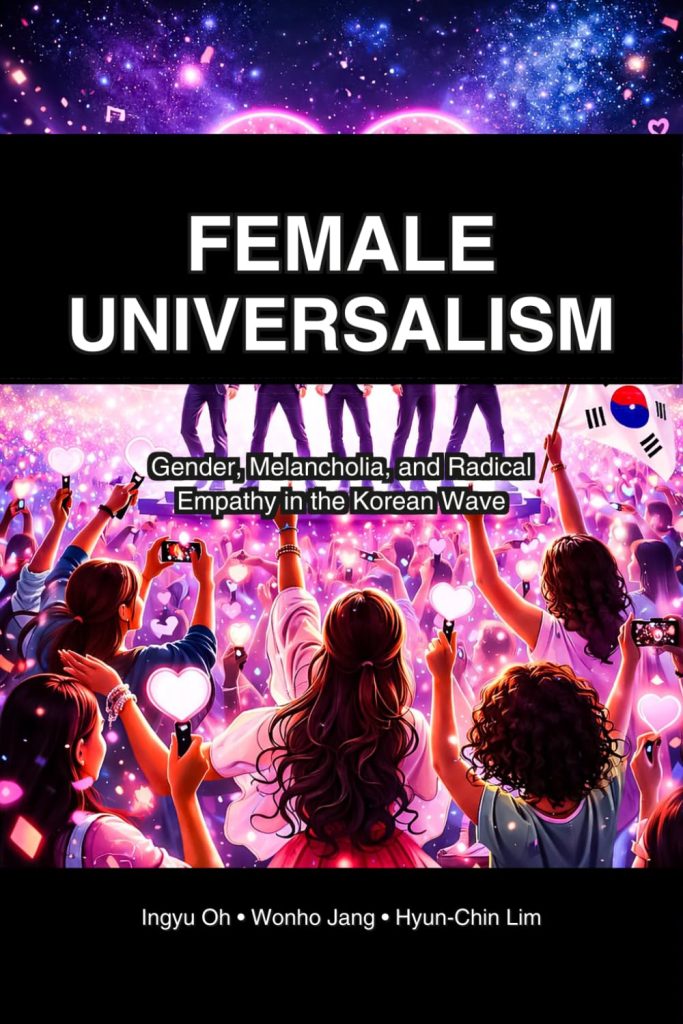
Female Universalism: Gender, Melancholia, and Radical Empathy in the Korean Wave
저자: 오인규(칸사이외국어대), 장원호(서울시립대), 임현진(아시아연구소)
World Association for Hally Studies (WAHS) Press, 2026
K-pop을 비롯한 한국 대중문화는 어떻게 전 세계 여성과 LGBTQ+의 연대와 정치적 의식을 형성하는가?
In June 2020, K-pop fans coordinated a massive campaign that left President Trump’s Tulsa rally humiliatingly empty—reserving hundreds of thousands of tickets they never intended to use. These same fans flooded Dallas Police Department tip lines during Black Lives Matter protests, crashed white supremacist hashtags, and organized fundraising campaigns that raised millions for social justice causes. When South Korean President Yoon Suk-yeol declared martial law in December 2024, K-pop fans were among the first to mobilize.
How did fans of Korean popular culture become a political force? Why are 70-80% of global Hallyu fans women, regardless of nationality, race, or class? And what does this have to do with South Korea’s fertility rate plummeting to 0.72—the lowest in the world?
Female Universalism offers a groundbreaking answer. Drawing on survey data from 218 K-pop fans across 47 countries, in-depth interviews with Japanese Hallyu fans, and analysis of consumption patterns from Korean fried chicken to buldak noodles, this book reveals how Korean popular culture has become the vehicle for global solidarity among women and LGBTQ+ individuals.
At the heart of this phenomenon lies “female universalism”—an alternative cultural framework to the white male universalism that has dominated global popular culture since the Enlightenment. Where Western pop culture centers male heroes saving passive women, Hallyu narratives feature women using creativity and community to solve problems. Where Hollywood celebrates stoic masculinity, Korean dramas showcase men who apologize, listen, and recognize women’s pain.
The book traces how personal pain transforms into collective action: structural oppression produces melancholia, which motivates creative engagement (fan art, translations), which generates community satisfaction, which cultivates radical empathy—the capacity to recognize others’ suffering across differences and commit to sustained political action. This isn’t escapism; it’s political consciousness developed through popular culture.
Through chapters examining Winter Sonata’s impact on Japanese women to the gendered politics of spicy Korean food, the book demonstrates that female universalism operates simultaneously as psychological process, cultural content, and political force. Japanese women use Korean dramas for “retrospective learning”—reflecting critically on their own society’s patriarchy. Global fans develop organizational skills through streaming campaigns that translate directly into protest mobilization.
The most provocative finding: female universalism is structurally linked to East Asia’s unprecedented fertility collapse. Women schooled in Hallyu’s narratives of female solidarity and self-actualization increasingly defer heterosexual partnership until ideal conditions emerge. They’re choosing sisterhood over motherhood—not permanently, but as a rational response to persistent patriarchy. K-pop fandoms become homosocial spaces where women find community and satisfaction that marriage under current gender regimes cannot provide.
Female Universalism challenges cynical dismissals of popular culture as corporate manipulation. It demonstrates how marginalized communities appropriate commercial culture for liberatory purposes, converting emotional pain into creative resistance. Fans aren’t passive consumers but active producers of meaning, community, and political consciousness.
Essential reading for scholars of media studies, gender studies, East Asian studies, and cultural sociology, this book also speaks to anyone seeking to understand how popular culture shapes politics, why young women increasingly reject traditional gender roles, and what Korea’s cultural exports reveal about global shifts in gender consciousness.
