

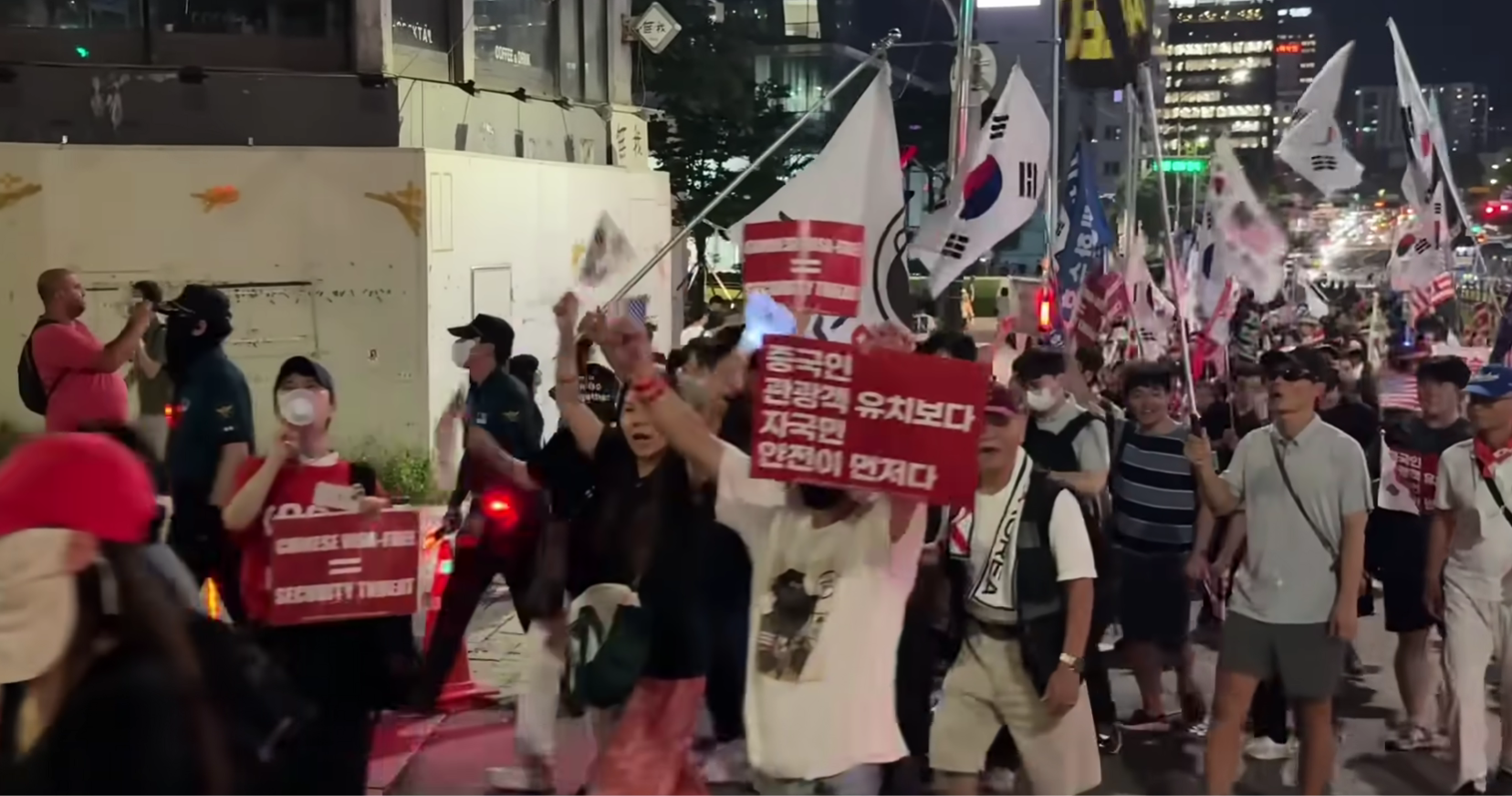
Source: YouTube (@Freeuniv0116)
Introduction
Despite the dispute between China and South Korea over the deployment of the Terminal High Altitude Area Defense System (hereafter the THAAD system) against North Korea’s possible provocations, Beijing has shown goodwill to South Korea, particularly after President Yoon Suk Yeol became South Korea’s president in 2022 (Kim, 2024). China’s engagement with South Korea aims to mitigate the pressure produced by the geo-political competition with the United States. Specifically, Beijing managed to preclude Washington’s alliance behavior in Northeast Asia from undermining its geo-political interests.
China’s engagement policy toward South Korea does not reduce the public’s negative perception of China within South Korean society. Instead, anti-China sentiment in South Korea has grown exponentially since the South Korean government introduced a visa-free program to Chinese tourists in fall 2025. Anti-China protests have been launched across tourist areas or regions with large Chinese populations. In fact, the growing anti-China sentiment in South Korea is largely attributed to the discrepant security interests between the two counties, associated with the negative attitude toward China-related political issues in South Korean society. Factors and implications of this phenomenon deserve deeper investigation.
Factors Contributing to the Growing Anti-China Sentiment in South Korea
A survey revealed that the percentage of South Koreans holding a negative attitude toward China has surpassed that toward Japan, South Korea’s former colonizer (Choe, 2021). Anti-China sentiment in South Korea commences with the discrepant interests over North Korea’s nuclear and missile issues. Subsequently, the disagreement toward political values, the controversy over China’s espionage activities, and conflict between Chinese tourists and the locals exacerbate South Koreans’ dissatisfaction toward China.
First, the misconceptions about China’s interests in security issues on the Korean Peninsula, coupled with Beijing’s response to Seoul’s decision to deploy the THAAD system, contribute to the rise of the anti-China sentiment in South Korea. With Seoul’s engagement policy toward China during the Park Geun-hye administration, some expected that China would cooperate with South Korea in promoting the denuclearization of the Korean Peninsula. However, the Chinese government considers whether the geo-political circumstance within the region would compromise its interests and security. In this regard, China expressed its strong dissatisfaction with North Korea’s two nuclear tests in 2016. Meanwhile, Beijing was concerned about the missile deployment within the South Korean territory would undermine China’s security (Han, 2019). For this reason, Beijing launched an array of economic sanctions against South Korean firms. The enforcement of sanctions enforcement and Beijing’s approach to Moon Jae-in’s visit to Beijing after his inauguration triggered South Koreans’ dissatisfaction toward China’s overreaction to Seoul’s defensive policy toward North Korea’s aggression and its “passive” attitude toward North Korea’s provocations (Han, 2019). The dispute exacerbated South Korean public frustration and reinforced skepticism toward China’s role in regional security.
Another significant factor contributing to anti-China sentiment in South Korea is disagreement over political values. Political movement in Hong Kong and the spread of the COVID-19 were the most obvious examples (Choi, 2023). China’s handling of the political situation in Hong Kong during 2019 drew criticism internationally and resonated negatively within South Korean society. Reports of protests and student clashes in Hong Kong have not only highlighted the region’s political tensions but also evoked memories of historical injustices experienced by Koreans, intensifying public empathy and frustration (Lee, 2019). Additionally, China’s strict “zero-COVID” policies, including its stringent pandemic control measures, have further fueled disapproval among South Koreans, who perceive these policies as authoritarian and overly rigid. These political and social developments have amplified perceptions that China’s governance values diverge sharply from South Korea’s democratic norms (Song, 2023).
Moreover, the perceived promotion of Chinese political influence has fueled anti-China sentiment in South Korea. Beijing has been accused of employing “sharp power” strategies to sway public opinion and gain access to sensitive information (Chung, 2024). Controversies have arisen over allegations of Chinese intelligence operatives operating in South Korea, as well as incidents in which Chinese nationals photographed military facilities under the pretext of curiosity (Lim, 2024). During the imposition of emergency measures by the South Korean president in 2024, these activities were cited as a security concern (Kim, 2025). Furthermore, amid the 2025 election period, reports emerged suggesting potential Chinese interference in South Korea’s electoral process (Kim, 2025). These incidents have amplified public suspicion regarding China’s intentions, reinforcing perceptions that Beijing seeks to assert political influence in South Korea beyond legitimate diplomatic engagement.
Finally, another source of anti-China sentiment in South Korea stems from the behavior of Chinese tourists. While most tourists behave appropriately, reports of misconduct and criminal incidents involving some travelers garnered significant media attention, fueling public frustration (Park, 2025). These incidents, ranging from minor violations of local norms to more serious offenses, contributed to the perception that Chinese tourists were disruptive and disrespectful. Consequently, such behaviors have reinforced negative stereotypes and exacerbated broader anti-China sentiment within South Korean society, illustrating how cultural and social interactions can influence diplomatic perceptions and public attitudes.
Implications of the Anti-China Sentiment in South Korea
The rise of anti-China sentiment in South Korea has not only shaped public opinion but also exerted multi-dimensional impacts across diplomatic, governmental, and societal levels. This sentiment, deeply rooted in security concerns and political distrust, continues to complicate Seoul’s policy choices and public attitudes toward China.
At the diplomatic level, although the South Korean government seeks to maintain stable relations with Beijing, the growing public hostility toward China limits Seoul’s flexibility in managing its foreign policy. The government faces increasing difficulty in balancing between its strategic partnership with China and its long-standing alliance with the United States. As public sentiment becomes increasingly critical of China, any attempt to engage Beijing is often interpreted domestically as a sign of weakness or concession. This public pressure complicates Seoul’s diplomatic maneuvering, forcing policymakers to tread carefully between economic cooperation with China and strategic coordination with Washington.
At the governmental level, policymakers are compelled to respond to domestic anti-China sentiment, often in a reactive rather than proactive manner. While trying to address public concerns, they also need to safeguard freedom of expression and avoid excessive censorship of online discourse related to China. The challenge lies in managing nationalist emotions while preventing them from undermining the broader national interests. In practice, the South Korean government must navigate a fine line—neither appearing too conciliatory toward Beijing nor overly hostile, as either stance could provoke domestic criticism or diplomatic retaliation.
At the individual level, the tension manifests in everyday interactions and perceptions. Negative media portrayals, cultural misunderstandings, and accumulated stereotypes have deepened the emotional distance between the two societies. Chinese tourists—who once played a vital role in South Korea’s tourism industry—are now often viewed with suspicion, and even minor incidents are easily magnified on social media, fueling further resentment. In this context, there is a growing need for stronger public education on tourism etiquette, cultural sensitivity, and mutual understanding. Local authorities and civic groups could also play a more active role in promoting people-to-people exchanges and dialogue programs to help reduce prejudice and prevent small disputes from escalating into diplomatic issues. Encouraging constructive communication and nurturing empathy between citizens of both countries are essential to reversing the current cycle of hostility.
Ultimately, the persistence of anti-China sentiment poses a challenge not only to bilateral relations but also to the broader stability of Northeast Asia. Public opinion has become a powerful new variable that governments can no longer ignore. Without sincere efforts from both sides to rebuild mutual trust—through transparency, consistent communication, and respect for each other’s sensitivities—such perceptions will continue to harden and may shape the trajectory of China–South Korea relations in a negative and long-lasting way.
저자 소개
Man Fung YEUNG (608270053@gms.tku.edu.tw)
completed his Ph.D. degree at the Graduate Institute of International Affairs and Strategic Studies, Tamkang University (Taiwan). His research focuses on Northeast Asia Security, alliance politics, economic sanctions, and public opinion toward defense and foreign policy. He received the 2025 Best Dissertation Award from the Association of International Relations, ROC—the largest academic organization in Taiwan in the field of international relations—on November 15, 2025, for his doctoral dissertation titled “Abandonment Anxieties and Alliance Coercive Diplomacy: A Case Study of China–North Korea Relations (1992–2022).”
참고문헌
Chung, Y. 2024. The Relational Dynamics of China’s Sharp Power and Korea’s Chordal Triad of Agency. Asian Perspective, 48(3), 387–408. https://muse.jhu.edu/pub/1/article/935483
Han, S. 2019. Resetting the South Korea–China Relationship: The THAAD Controversies and Their Aftermath. The Korean Journal of Defense Analysis, 31(4), 539–557.
Kim, D. 2024. Explaining China’s Cautious Responses to the Strategic Choices of the Yoon Administration. Issues and Studies, 60(2).
Kim, S. 2025. What Went Wrong with President Yoon? Global Asia, 20(1), 8–13.
Kim, S. 2025. S. Korea views White House comments about Chinese interference unrelated to election: Official. Yonhap News Agency. https://en.yna.co.kr/view/AEN20250605008600315
Lee, M. 2019. South Korean students voice support for Hong Kong protests. Yonhap News Agency. https://en.yna.co.kr/view/AEN20191119005400315
Lim, E.-W. 2024. Chinese student accused of filming U.S. aircraft carrier in Busan was model Communist Party member: Seoul. Korea JoongAng Daily. https://koreajoongangdaily.joins.com/news/2024-12-02/national/defense/Chinese-student-accused-of-filming-US-aircraft-carrier-in-Busan-was-model-Communist-Party-member-Seoul/2190619
Park, U. 2025. Jeju residents unsettled by rise in Chinese tourist crimes. The Korea Times. https://www.koreatimes.co.kr/southkorea/society/20250404/jeju-residents-unsettled-by-rise-in-chinese-tourist-crimes
Sang-Hun, C. 2021. South Koreans Now Dislike China More Than They Dislike Japan. The New York Times. https://www.nytimes.com/2021/08/20/world/asia/korea-china-election-young-voters.html
Song, E. E. 2023. COVID-19, Anti-Chinese Sentiment, and Foreign Policy Attitudes in South Korea. Asian Survey, 63(5), 823–850.
